Kuwait City is Kuwait’s commercial and administrative capital, and by any measure its most dynamic food service market. The city’s restaurant landscape has transformed at a pace that would have been unrecognisable a decade ago: mixed-gender dining, international fine dining destinations, a booming café culture, and one of the highest concentrations of international QSR franchise outlets in the Middle East. For procurement managers responsible for Kuwait City-based HORECA operations, packaging sourcing in 2026 is a function of navigating SFDA compliance, managing Ramadan demand spikes, and finding reliable supply at a price point that keeps unit economics viable.
Kuwait City’s Food Service Market: Scale and Growth Context
Kuwait City’s food service market is the largest single city market in the GCC, driven by a population that has grown to over 8 million and a Vision 2030-driven shift in social policy that has fundamentally restructured the dining economy. Key market dynamics shaping packaging demand:
- QSR expansion: McDonald’s Kuwait operates over 400 locations nationally, with a substantial concentration in Kuwait City. Starbucks, Burger King, Subway, and dozens of regional chains operate hundreds of additional outlets. Each outlet generates consistent, high-volume packaging consumption across gloves, napkins, food containers, and bin liners.
- Casual dining growth: The opening of mixed-gender dining in 2018 triggered a wave of new restaurant openings in Kuwait City’s entertainment districts — King Abdullah Financial District (KAFD), the Boulevard, and Diriyah Gate. These venues drive demand for premium presentation packaging.
- Food delivery dominance: HungerStation (acquired by Delivery Hero) and Jahez have built one of the world’s most active food delivery markets in Kuwait. Kuwait City alone accounts for an estimated 35–40% of national food delivery orders, generating enormous demand for delivery-optimised packaging.
- Ramadan economy: Kuwait City’s Ramadan catering season — iftar gatherings, corporate iftars, hotel tent events — compresses what would otherwise be two months’ of catering packaging consumption into a four-week period. Operators who fail to pre-stock adequately face supply shortages and above-market emergency pricing.
SFDA Compliance for Kuwait City Food Service Operators
The kuwait Food and Drug Authority (SFDA) enforces food packaging standards through both pre-market product registration and on-site HORECA inspections. Kuwait City Municipality conducts regular inspections of commercial kitchens, and non-compliant packaging can result in fines, forced removal of product, and — in severe cases — temporary closure.
| Packaging Category | SFDA Requirement | Documentation Needed | MIMI Compliance Status |
|---|---|---|---|
| Disposable gloves | Food-contact grade, latex-free declaration | CoA + material safety declaration | ✅ Full documentation available |
| Aluminium foil containers | Food contact migration testing | Migration test report + CoA | ✅ EU/FDA standard reports |
| Cling film / stretch wrap | Food-grade polymer, no prohibited plasticisers | Material composition + CoA | ✅ PFAS-free, compliant |
| Baking paper | Food contact, bleach-free or elemental-chlorine-free | Manufacturing process declaration | ✅ Silicone-coated, ECF |
| Bin liners (kitchen) | Non-food-contact; no specific SFDA requirement | None required | ✅ Standard supply |
Managing Ramadan Packaging Demand in Kuwait City
Ramadan creates the most predictable and most consequential demand spike in the kuwait HORECA calendar. For packaging procurement managers in Kuwait City, the planning window is critical. Sea freight from manufacturing origins takes 18–25 days to reach kuwait ports; customs clearance adds 3–7 days. Operators who begin Ramadan procurement less than 60 days before the start of the holy month are at serious risk of supply gaps.
The categories most affected by Ramadan demand spikes in Kuwait City:
- Aluminium foil containers (all sizes): Used for iftar meal preparation, corporate catering deliveries, and hotel tent service. Demand typically increases 3–5x during Ramadan versus the preceding month.
- Disposable serving trays and platters: Large-format presentation packaging for communal iftar meals. Often the most difficult category to source locally at short notice.
- Vinyl (PVC) and vinyl gloves: Catering operations running extended kitchen hours for suhoor service require higher than normal glove consumption. Demand increase of 50–80% above baseline is typical.
- Heavy-duty bin liners: Higher food preparation volumes generate significantly more kitchen waste. CoreShield™ LLDPE liners in 60L and 100L formats are the standard specification for Kuwait City hotel kitchens during Ramadan.
Sourcing Packaging for Kuwait City: Getting the Economics Right
Kuwait City’s packaging supply market is served by several large kuwait trading companies — including members of well-known conglomerates with FMCG distribution arms — as well as regional distributors shipping from Kuwait and direct-import buyers. The economics of each channel differ significantly:
| Channel | Markup vs Landed Cost | Kuwait City Lead Time | Ramadan Reliability |
|---|---|---|---|
| Large kuwait trading company | 45–70% | 1–3 days | Medium — stock depletes fast |
| Kuwait/Kuwait City regional distributor | 25–45% | 4–8 days (truck) | Medium — cross-border delays possible |
| Direct import (sea freight) | Manufacturer margin only | 22–30 days | High — if planned 60+ days ahead |
The optimal strategy for most Kuwait City HORECA operators combines direct import for baseline high-volume categories (gloves, bin liners, kitchen paper) with a local distributor relationship maintained for emergency top-up orders. This hybrid approach captures the unit cost benefits of direct import while preserving operational flexibility.
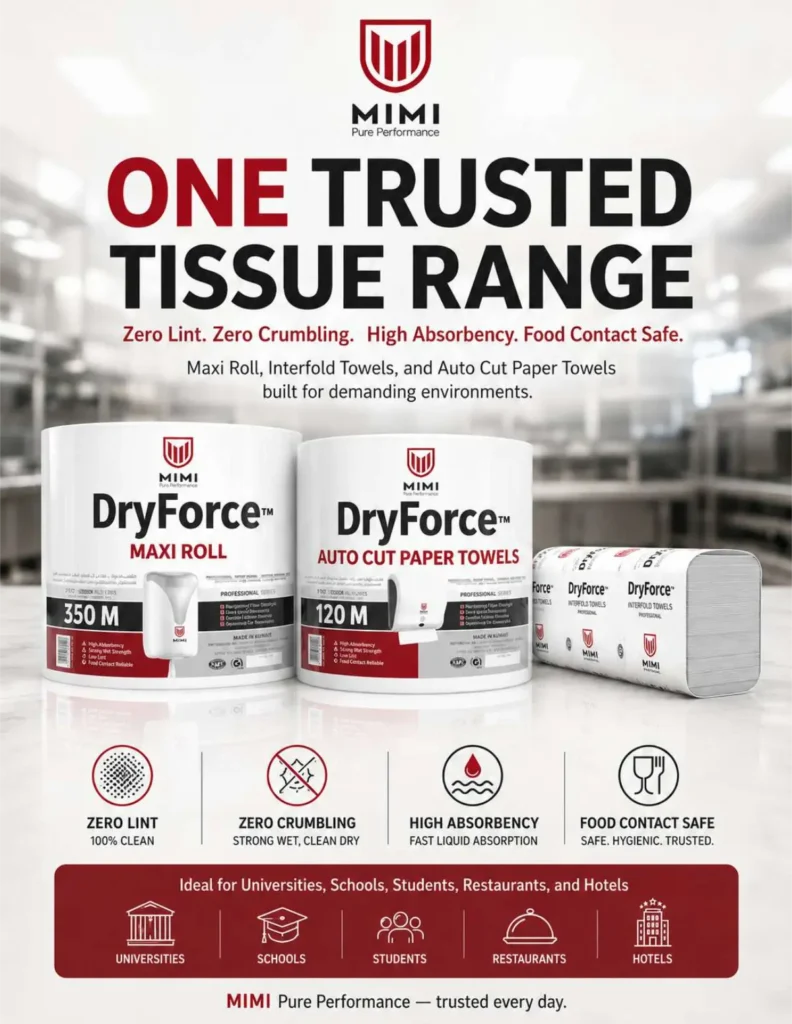
MIMI Pure Performance supplies HORECA operators in Kuwait with professional-grade kitchen disposables and paper products. Our current product range includes FreshWrap™ food cling film and aluminum foil, PURITY-BAKE™ premium baking paper, ChefShield™ PVC disposable gloves, and the DryForce™ professional paper towel series — including commercial maxi rolls, auto-cut towels, V-fold interfold towels, and household soft tissue packs. Our CoreShield™ heavy-duty garbage bags (LLDPE, available from 10L to 500L with colour-coded sorting) complement our kitchen disposables range for Kuwait HORECA operators who need a complete waste management solution alongside their kitchen consumables.
Ready to discuss your kitchen disposables and paper product supply in Kuwait? Contact MIMI Pure Performance — we work with HORECA operators across Kuwait to build efficient, compliant supply chains for professional kitchen operations.
Why MIMI Stands Apart: The Sourcingate Advantage
Unlike Kuwait suppliers who rely on third-party traders, MIMI Pure Performance is backed by Sourcingate — our China headquarters in Wenzhou, Zhejiang. Sourcingate manages brand operations, supplier vetting, factory audits, quality inspection, and export logistics in-house. Our dedicated QC team works directly with vetted factories, ensuring every MIMI product meets HORECA-grade performance standards before it ships to Kuwait.
This direct China-to-Kuwait supply chain means better quality control, lower procurement cost, and consistent supply — advantages that local-only competitors cannot match. From raw material selection to final pre-shipment inspection, Sourcingate oversees every stage so Kuwait HORECA operators receive reliable, certification-ready products every order.
Want a partner with on-the-ground supplier management and quality control? Get in touch with MIMI Pure Performance — our China-Kuwait team is ready to support your HORECA operation.